
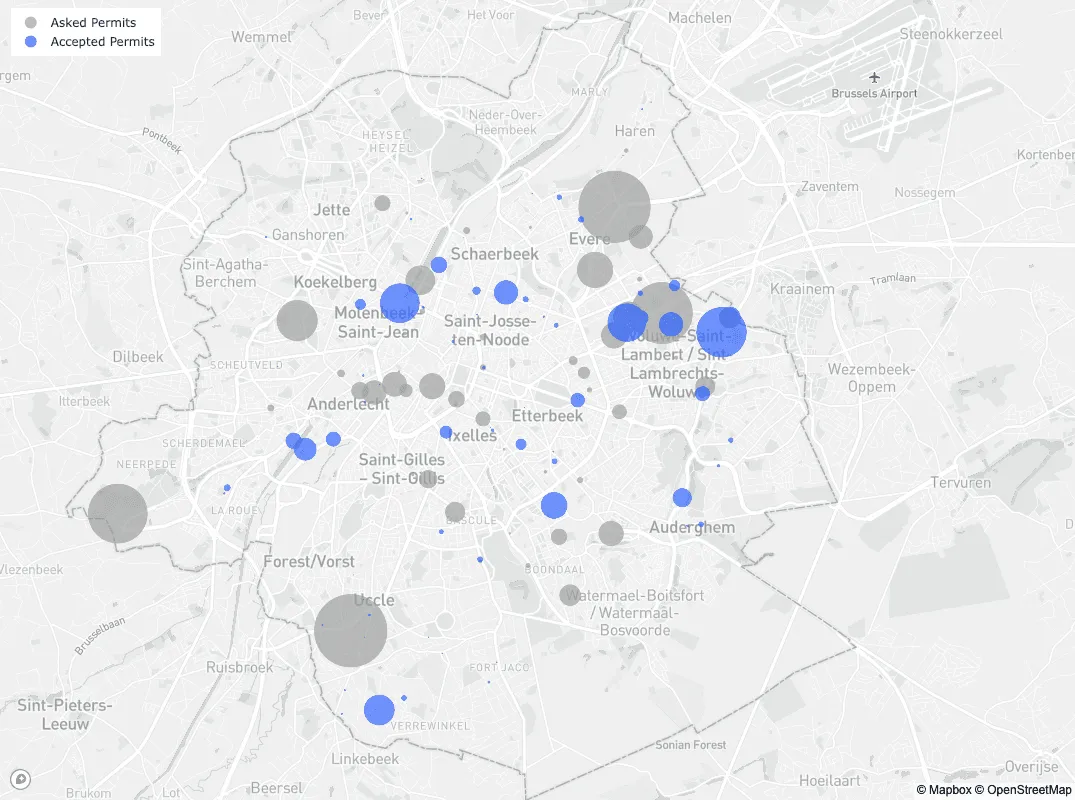
All permits in Brussels are available on the OpenPermits platform. We analysed these permits to extract interesting statistics on permits requested and granted in Brussels.
In this article
- Urban planning permits
- A growing number of applications
- Significant disparities between municipalities
- 89% of permits granted
- Housing development projects
- What characteristics?
- The largest upcoming projects
Urban planning permits
An urban planning permit is required for a series of construction or transformation acts. These acts subject to a permit are specified in the CoBAT, the legal basis of Urbanism and Town Planning in Brussels.
A growing number of applications
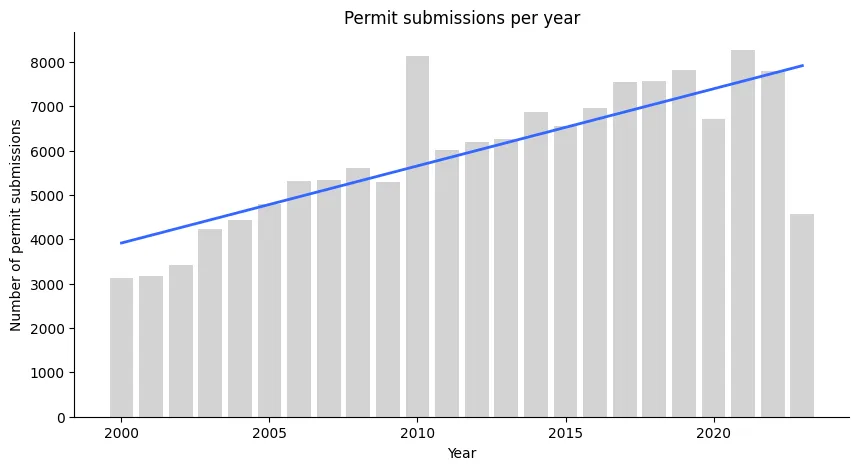
As shown in the chart below, the number of permit applications has grown steadily for more than 20 years. Each year, on average 173 more permits are recorded than the previous year. In 2022, for example, 7,784 permits were requested in the Brussels-Capital Region.
Significant disparities between municipalities
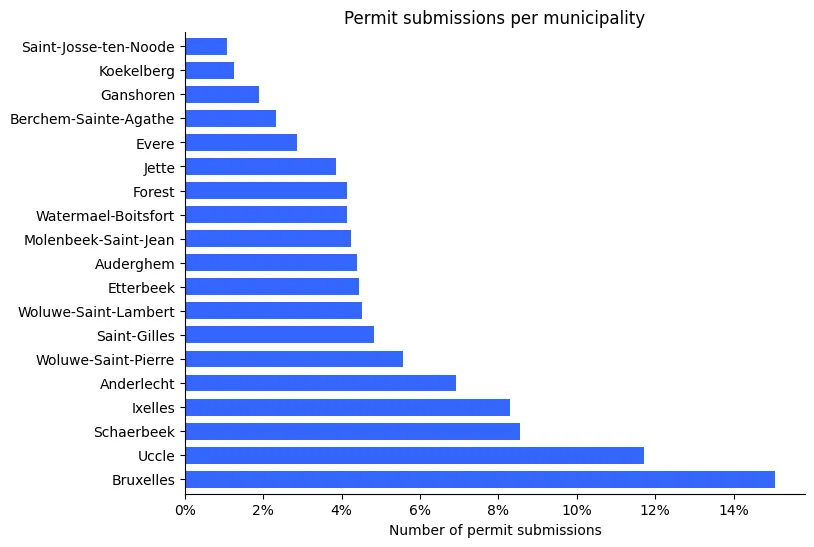
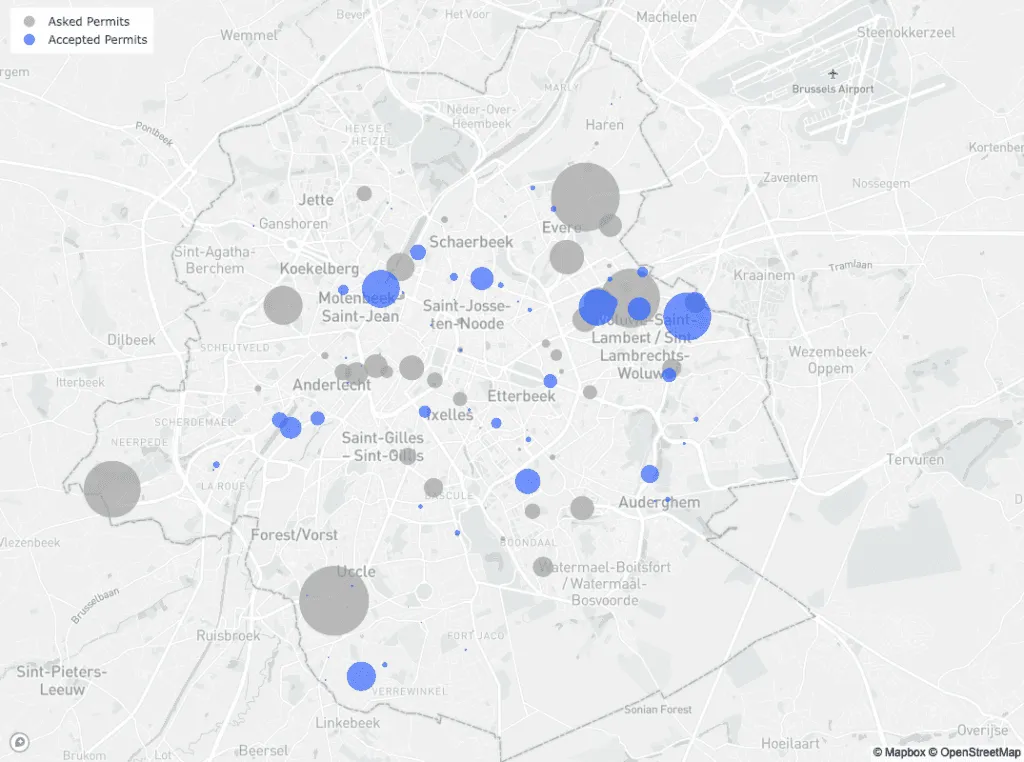
As shown in the illustration below, some municipalities are far more active in terms of the number of permits requested. Brussels (the city) leads with 15% of applications, while Saint-Josse-ten-Noode accounts for only 1% of the total permit volume.
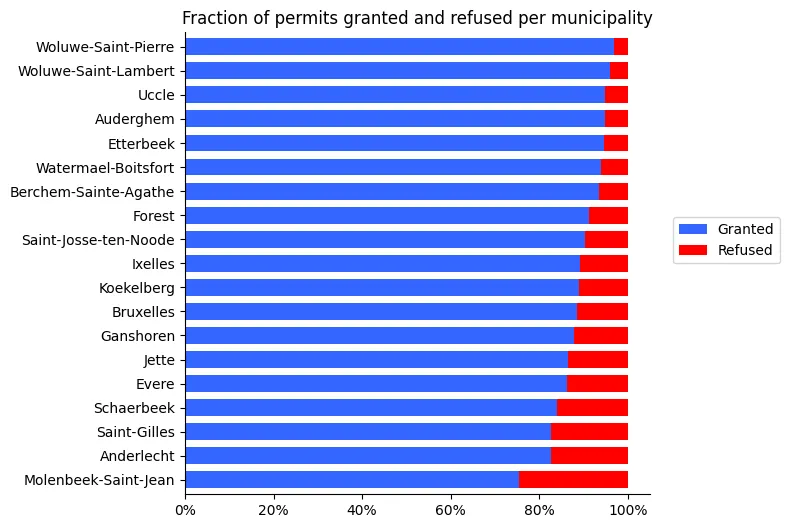
Of course, not all permit applications are granted, and there are significant differences in the approval rate depending on the municipality.
89% of permits granted
The municipalities in the south-east of Brussels (Woluwe, Uccle, Auderghem, Etterbeek, Watermael) grant a higher percentage of permits than the municipalities in the north (Schaerbeek, Evere, Anderlecht, Molenbeek). This rate ranges from 75% (Molenbeek) to 95% (Woluwe-Saint-Pierre), with an average of 89%. It is important to note that urban planning permits include applications for acts that are not construction (for example: insulating a gable wall, regularising a dwelling, felling a tree, etc.)
Housing development projects
The construction of residential buildings is subject to an urban planning permit. These projects can be identified, via the permit application, by an increase in the surface area allocated to housing, as well as keywords such as “construction”, “renovation”, “apartment building”, etc. We identified 630 projects matching these criteria.
Here are a few examples that fall under this definition:
- Demolition of a car garage and reconstruction of an apartment building
- Extension of a building to create 4 new dwellings
- Conversion of an office building into housing
What characteristics?
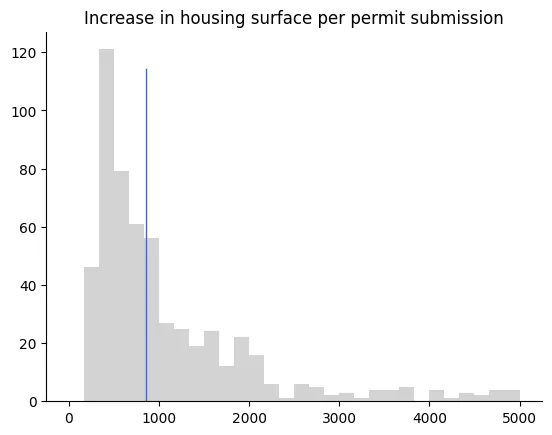
Development projects vary considerably in scale. We only selected projects creating at least 300 m² of housing. The majority of housing development permits plan to create less than 850 m² of housing. The most ambitious 10% of projects aim to create 5,000 m² or more.
The largest upcoming projects
Based on the criteria established, we identified the permits with the most authorised m² over the past three years. These are therefore the upcoming projects.
 Reference Reference |
Address | Approved housing surface [m2] |
|---|---|---|
| 18/PFD/1791015 | Rue Neerveld 105-107, 1200 Woluwe-Saint-Lambert | 15375.0 |
| 12/PFD/1767823 | Quai des Charbonnages 88-90, 1080 Molenbeek-Saint-Jean | 12183.43 |
| 06/PFD/1772514 | Rue Colonel Bourg 120, 1140 Evere | 11843.5 |
| 16/PFD/1760152 | Homborch 71a-71e, 1180 Uccle | 9500.1 |
| 09/PFD/1839512 | Avenue de la Couronne 486-498, 1050 Ixelles | 8264.5 |
| 18/PFD/1825155 | Rue d’Attique , 1200 Woluwe-Saint-Lambert | 7592.41 |
| 15/PU/1779437 | Rue des Coteaux 221-223, 1030 Schaerbeek | 7574.4 |
| 01/PFD/1784916 | Rue de la Filature , 1070 Anderlecht | 7125.0 |
| 18/PFD/1799263 | Boulevard de la Woluwe 102, 1200 Woluwe-Saint-Lambert | 6748.0 |
| 02/PFD/1864255 | Boulevard du Souverain 360, 1160 Auderghem | 6005.0 |
| The 10 largest projects approved (31/08/2023) |