
Yes, since 2021. The median gross rental yield on apartments in Belgium went from 3.9% in 2021 to 4.1% in 2025, according to SmartBlock’s analysis of sale and rental listings in 168 municipalities tracked every year. Brussels saw the largest increase, from 4.6% to 5.1%, because rents there rose by 20% while sale prices rose by 7%.
Background: how we tracked rental yield
Gross rental yield is the annual rent divided by the purchase price. For each municipality and each year, we calculated the median rent per square metre of apartments listed for rent and the median price per square metre of apartments listed for sale, then the ratio between the two. The regional figure is the median of the municipalities in the region.
Tracking a yield over time has a pitfall: if the sample changes, the trend measures the change in sample as much as the market. We therefore used a fixed panel of 168 municipalities, present every year from 2019 to 2025 with at least 20 sale listings and 20 rental listings: the 19 Brussels municipalities, 44 Flemish municipalities and 105 Walloon municipalities.
The rents measured are the asking rents in listings, in other words those of new leases. Sitting tenants often pay less, because their rent only moves with indexation. For an investor buying a property to let, however, the rent in new listings is the one that counts.
Gross yield does not deduct registration duties, property withholding tax, service charges or vacant months. It is a tool for comparing years and regions with one another. To estimate the net income of a specific investment, you have to start from the property, its condition and the owner’s actual costs.
How has rental yield in Belgium changed since 2019?
The yield in Belgium followed a U-shaped curve. It fell from 2019 to 2021, held at the same level in 2022, then rose every year until 2025, ending slightly above its starting level.
| Year | Belgium | Brussels | Flanders | Wallonia |
|---|---|---|---|---|
| 2019 | 4.03% | 4.73% | 4.02% | 3.87% |
| 2020 | 4.01% | 4.66% | 3.88% | 3.91% |
| 2021 | 3.91% | 4.60% | 3.80% | 3.91% |
| 2022 | 3.90% | 4.68% | 3.83% | 3.84% |
| 2023 | 3.98% | 4.81% | 3.84% | 3.92% |
| 2024 | 4.08% | 5.01% | 3.97% | 4.00% |
| 2025 | 4.14% | 5.10% | 4.10% | 4.05% |
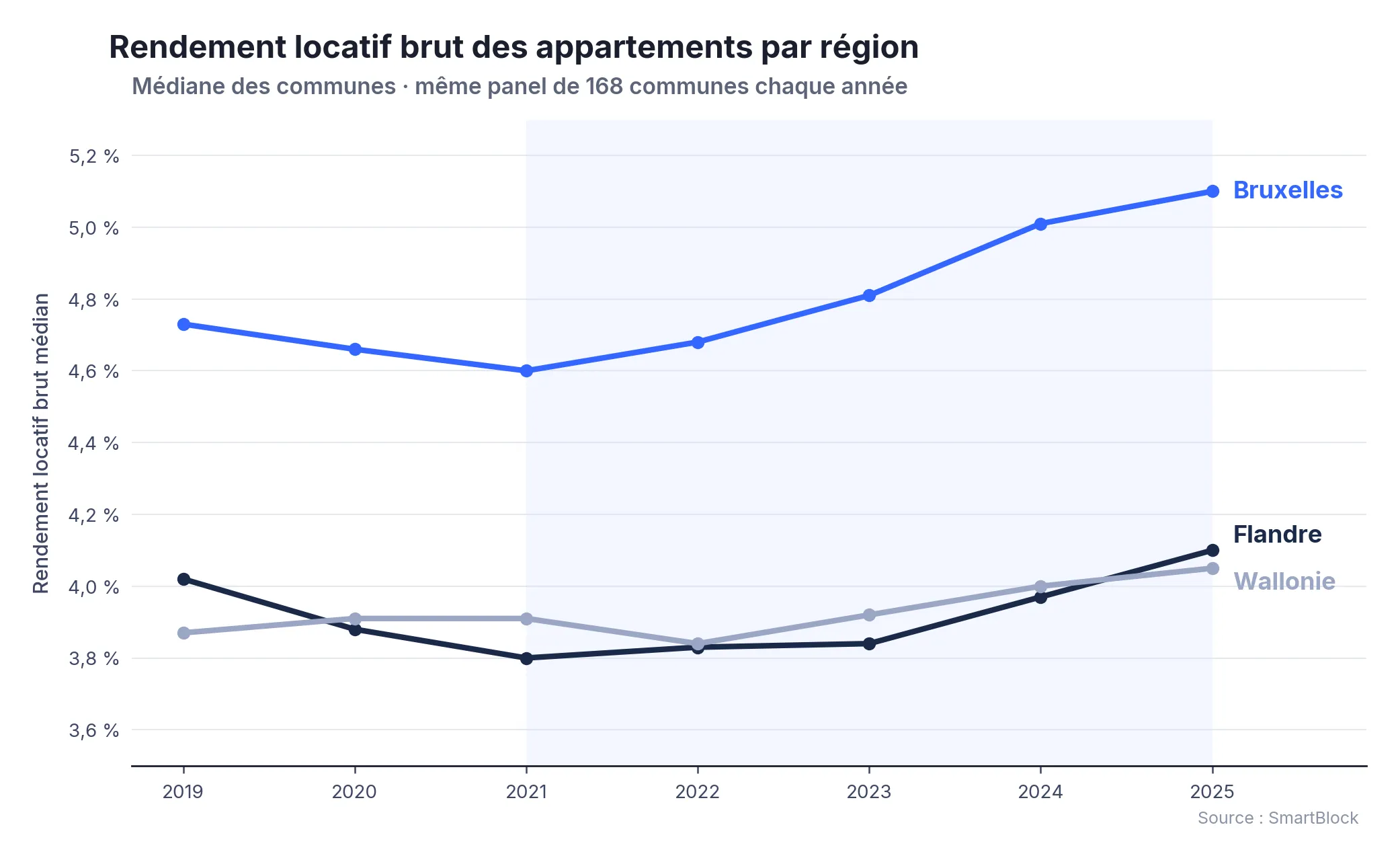
The median gross rental yield on Brussels apartments went from 4.60% in 2021 to 5.10% in 2025; in Flanders and Wallonia, it returned to around 4.1%. Source: SmartBlock, apartment listings 2019-2025, panel of 168 municipalities.
The Brussels-Capital Region stays well above the other two regions throughout the period, with a gap of one point in 2025. Flanders and Wallonia move almost in step: Flanders fell further between 2019 and 2021, then caught up with Wallonia in 2025.
At national level, the gap between the 2021-2022 low (3.9%) and 2025 (4.14%) may look small. On a €250,000 apartment, however, it represents €600 more in annual rent for the same purchase price.
Why did rental yield fall until 2021?
Between 2019 and 2021, sale prices rose faster than rents. The median price per square metre of the panel’s apartments went from €2,484 to €2,768, an increase of 11% in two years, during a period of low mortgage rates when buyers could borrow cheaply.
Rents, meanwhile, kept to their usual pace. An ongoing lease only moves with annual indexation, and rents in new listings adjust to the market gradually. When prices jump, the yield for new buyers falls.
Brussels illustrates this lag between prices and rents. The median apartment price there went from €2,789/m² in 2019 to €3,292/m² in 2021, and the Brussels yield dropped from 4.73% to 4.60%.
Why did rental yield rise again after 2021?
After 2021, the trend reversed: between 2021 and 2025, in all three regions, rents rose much faster than sale prices, up to three times faster in Brussels.
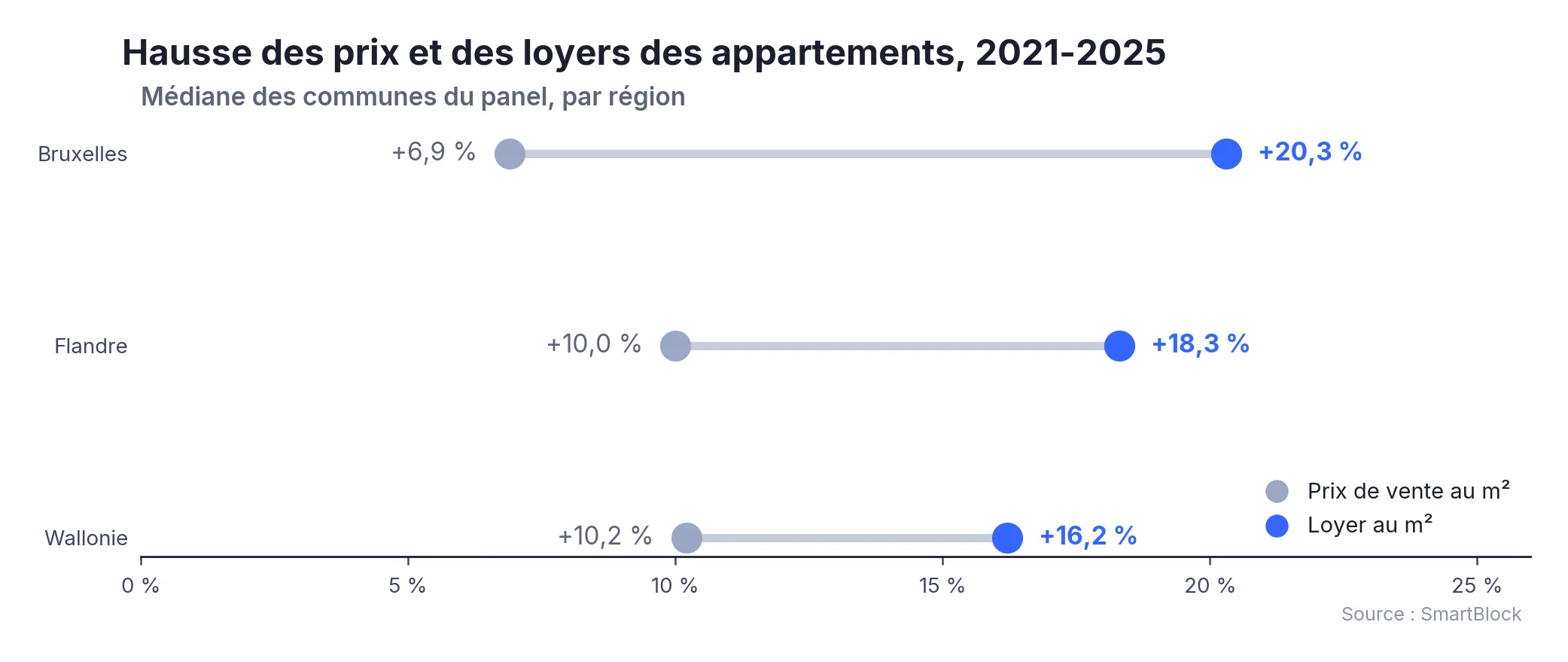
Between 2021 and 2025, the median rent per square metre of apartments rose by 20.3% in Brussels, against 6.9% for the sale price. Source: SmartBlock, median of the panel municipalities.
| Region | Sale price increase | Rent increase | Municipalities where yield rose |
|---|---|---|---|
| Brussels | +6.9% | +20.3% | 95% |
| Flanders | +10.0% | +18.3% | 70% |
| Wallonia | +10.2% | +16.2% | 66% |
Two movements crossed. On the rent side, the 2022 inflation pushed up the indexation of ongoing leases, and asking rents in new listings followed. On the price side, the rise in mortgage rates from 2022 onwards reduced buyers’ borrowing capacity and slowed the rise in sale prices.
Brussels combines both effects. Apartment prices there rose the least of the three regions, and rents the most. Of the 19 Brussels municipalities, 18 saw their yield increase between 2021 and 2025.
In Wallonia, the movement is more mixed: the yield rose in two out of three municipalities in the panel, and fell in the others.
Do an owner and a new buyer see the same rental yield?
No. The yield on a property is calculated on its purchase price, which no longer changes once the deed is signed, while the rent keeps evolving.
An investor who bought a Brussels apartment in 2019 at the median price obtained a gross yield of 4.73% in the first year. As Brussels rents rose by around 30% between 2019 and 2025, the same apartment brings in around 6% of its purchase price in 2025. In Flanders, the same calculation gives around 5.2%, and in Wallonia around 4.8%.
Over the whole 2019-2025 period, both curves rose in all three regions, but rents stayed one step ahead.
| Region | Sale prices 2019-2025 | Rents 2019-2025 |
|---|---|---|
| Brussels | +20.9% | +29.8% |
| Flanders | +24.0% | +28.3% |
| Wallonia | +22.4% | +25.0% |
Flanders shows the strongest price increase over six years, concentrated between 2019 and 2021: that is why its yield first fell the most, from 4.02% to 3.80%, before rising again when rents took over from 2023 onwards. In Wallonia, prices and rents moved almost in step: it is the region where the 2025 yield is closest to that of 2019.
A new buyer, on the other hand, pays the 2025 price and obtains the 2025 market yield: 5.1% in Brussels, around 4.1% in Flanders and Wallonia. Rising rents therefore benefit those who have already bought first; for newcomers, only the relative movement of rents and prices matters.
What these figures mean for property professionals
For a buy-to-let investor
The 2025 market offers a gross yield slightly above that of 2019, especially in Brussels. The recovery is partly due to the exceptional indexation of 2022 and 2023, which will not be repeated every year: if rates fall and prices start rising faster than rents again, the yield on new purchases can come back down.
The average yield of a region says little about a specific municipality. Our ranking of the 20 largest cities shows yields that vary twofold, from 3.3% in Kortrijk to 6.5% in Charleroi.
For a property valuer
A capitalisation rate set on 2021 data is too low for Brussels in 2025: applied to a 2025 rent, a rate of 4.6% instead of 5.1% overvalues the property by around 11%. For a valuation by capitalisation, the reference rate should be updated every year with the municipality’s listings.
Frequently asked questions
Has rental yield increased in Belgium?
Yes, since 2021. The median gross rental yield on apartments in Belgium went from 3.91% in 2021 to 4.14% in 2025, after a decline between 2019 and 2021. The increase comes from rents, which rose much faster than sale prices.
What is the rental yield in Brussels in 2025?
The median gross rental yield on apartments in the 19 Brussels municipalities is 5.10% in 2025, up from 4.60% in 2021. It ranges from 4.5% in Ixelles to 6.1% in Molenbeek.
Have rents risen faster than property prices in Belgium?
Since 2021, yes. The median rent per square metre of apartments rose by 20% in Brussels, 18% in Flanders and 16% in Wallonia, against 7 to 10% for sale prices. Between 2019 and 2021, it was the other way round.
Which Belgian region offers the best rental yield?
Brussels, with a median gross rental yield on apartments of 5.10% in 2025, against 4.10% in Flanders and 4.05% in Wallonia. The gap between Brussels and the other two regions has widened since 2021.