
On 1 January 2026, a Belgian house stays with the same owner for 18.2 years on average, and an apartment for 9.9 years, according to SmartBlock’s analysis of land registry data from FPS Finance. The gap between the two has more than doubled in fifteen years: from 3.9 years in 2011 to 8.2 years in 2026.
Background: what the holding period measures
Every year, FPS Finance publishes as open data the ownership dynamics of every cadastral parcel in Belgium, from national level down to the municipality. We rebuilt the full series, from 1 January 2011 to 1 January 2026, or sixteen annual editions. Le Vif reported these figures in early October 2026.
The main indicator is the average ownership turnover period: the average length of time a single holder owns a property before ownership changes. A change of ownership is not limited to a sale. It also includes inheritances and gifts, which makes this indicator a measure of how often a property changes hands, broader than the time before resale alone.
Two caveats apply to the figures. For rights dating from before 1975, less than 2% of the total, FPS Finance sets the start date by convention at 1 January 1975. And legacy cadastral nature codes, no longer assigned since 2015 and 2018, are excluded: a parcel leaves them as soon as it is reclassified, so their average age reflects a selection effect rather than market behaviour.
How long do people keep a house in Belgium?
A little over eighteen years. On 1 January 2026, the average holding period is 18.2 years for a house, the same as for a plot of land, and 9.9 years for an apartment. The apartment is the property that changes hands most often, well ahead of retail premises (13.7 years) and industrial buildings (15.1 years).
| Property type | Belgium | Brussels | Flanders | Wallonia |
|---|---|---|---|---|
| Apartments | 9.9 years | 11.7 years | 9.6 years | 9.0 years |
| Retail and services | 13.7 years | 15.0 years | 13.3 years | 13.9 years |
| Industrial buildings | 15.1 years | 17.7 years | 14.2 years | 16.4 years |
| Houses | 18.2 years | 19.7 years | 18.1 years | 18.1 years |
| Land | 18.2 years | 21.3 years | 17.6 years | 18.9 years |
| Public and community buildings | 22.7 years | 24.0 years | 19.7 years | 26.2 years |
Average ownership turnover period on 1 January 2026. Source: FPS Finance, property ownership dynamics, SmartBlock analysis.
Brussels stands out for houses. A Brussels house stays with the same owner for 19.7 years on average, against 18.1 years in Flanders and Wallonia. Houses are scarce there, around 124,000 parcels against 292,000 apartments, and their owners sell them less often than elsewhere.
For apartments, the order is reversed: Brussels has the longest period (11.7 years), Wallonia the shortest (9.0 years). The share of new homes weighs on this result. A new apartment enters the stock with a holding period of a few years, which pulls the average down in regions where many apartments are built relative to the existing stock.
Why are houses being kept longer and longer?
The two main housing segments have moved in opposite directions since 2011. In Belgium, the holding period for houses rose from 16.3 years in 2011 to 18.2 years in 2026. For apartments, it fell from 12.3 years to 9.9 years.
Average holding period in Brussels, by property type
Average ownership rotation period, in years, at 1 January
Source: FPS Finance, Real estate ownership dynamics, 2011-2026 editions, SmartBlock analysis
Average holding period in Flanders, by property type
Average ownership rotation period, in years, at 1 January
Source: FPS Finance, Real estate ownership dynamics, 2011-2026 editions, SmartBlock analysis
Average holding period in Wallonia, by property type
Average ownership rotation period, in years, at 1 January
Source: FPS Finance, Real estate ownership dynamics, 2011-2026 editions, SmartBlock analysis
From 2011 to 2026, the holding period for houses rises in all three regions (by 2.1 years in Brussels, 1.6 years in Flanders and 2.3 years in Wallonia), while the period for apartments falls (by 1.5 years in Brussels, 2.5 years in Flanders and 2.8 years in Wallonia). Source: FPS Finance, SmartBlock analysis.
The trend holds in every region, which rules out a purely local explanation. No recent Belgian study settles which of the possible causes dominates, but three mechanisms are probably at work together.
The first is the housing path. An apartment is often a first step, sold when starting a family or buying a house; a house is bought to last. The second is the cost of the transaction: when prices rise, registration duties and moving costs weigh more, and a homeowner is more reluctant to sell and buy again. The third is the make-up of the apartment stock, which is growing fast: Belgium had 738,000 apartment parcels in 2011 and 1,368,000 in 2026. Every new building adds apartments held for less than five years, which lowers the average without existing owners selling any faster.
Across all property types, the trend therefore depends first on the make-up of the stock. The average period rises by 1.5 years in Wallonia, where land carries a lot of weight, remains stable in Flanders and falls by 1.1 years in Brussels, where apartments are in the majority.
What share of the stock has not changed hands for twenty years?
Nearly a quarter. On 1 January 2026, 23.5% of Belgian parcels have not changed owner for more than twenty years, while 30.7% changed owner in the last five years.
| Time since last change of ownership | All properties | Houses | Apartments |
|---|---|---|---|
| Less than 5 years | 30.7% | 25.8% | 39.4% |
| 5 to 10 years | 24.0% | 21.7% | 31.1% |
| 10 to 20 years | 21.8% | 23.1% | 20.3% |
| More than 20 years | 23.5% | 29.5% | 9.2% |
Houses account for most of this long-held stock. Nearly three houses in ten (29.5%), or 1,065,000 houses, have been held by the same owner for more than twenty years. There were 816,000 in 2011: this stock grew by 30% in fifteen years. For apartments, the share falls to 9.2%.
Wallonia has the highest share of properties held for more than twenty years (27.2%), ahead of Flanders (21.7%) and Brussels (16.8%). Conversely, Brussels has the highest proportion of properties acquired less than five years ago, 33.2%.
This stock will come back onto the market through resale or inheritance. These are often older houses, some of which will need an energy renovation. In Flanders, the buyer of a home rated E or F on the EPC must already reach label D within five years: the cost of the works is factored into the price at the time of sale. The profile of property buyers, aged 40 on average, tells us who will take over these properties.
In which municipalities do people keep their house the longest?
In former industrial areas of Wallonia, in Brussels and in a few university towns. Among municipalities with at least 500 houses, Ottignies-Louvain-la-Neuve (22.8 years), Chapelle-lez-Herlaimont (22.6 years), Fléron and Saint-Josse-ten-Noode (22.2 years) have the longest holding periods.
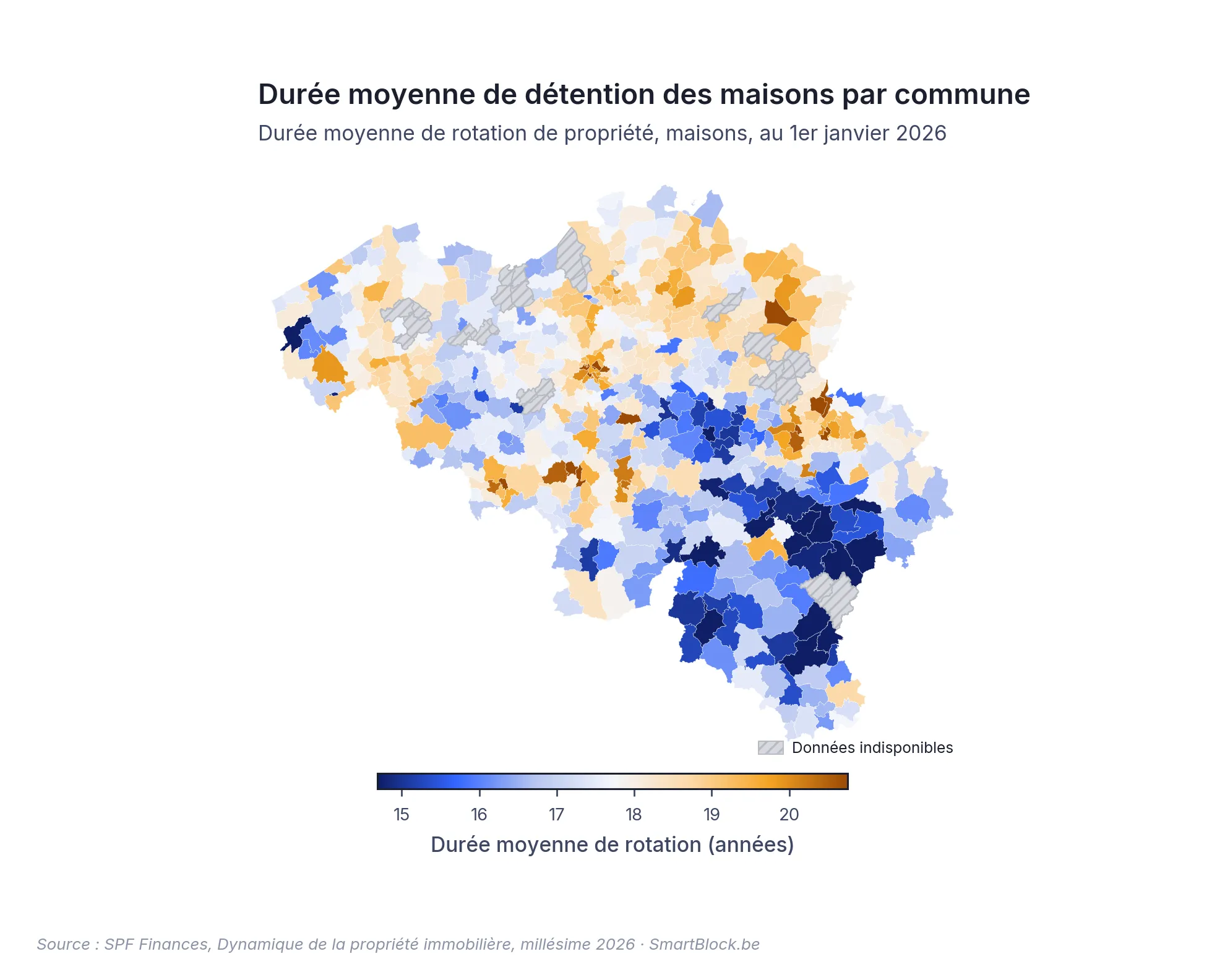
On 1 January 2026, houses change owner most often in the Ardennes, at around 14 years, and least often along the Walloon industrial belt and in Brussels, at over 21 years. Source: FPS Finance, SmartBlock analysis.
At the other end, houses change hands most often in the Ardennes: 13.8 years in Somme-Leuze, 14.0 years in Erezée, 14.1 years in Rendeux and in Vaux-sur-Sûre. These tourist municipalities have many second homes, bought and resold more often than a main residence, which probably explains part of the gap.
In Brussels, the gap between municipalities is sharper than one might expect. Houses in Uccle change owner every 17.1 years on average, those in Woluwe-Saint-Pierre every 18.5 years. In Saint-Josse-ten-Noode and Molenbeek-Saint-Jean, the period exceeds 21 years. For Brussels apartments, the order changes again: turnover is fastest in the City of Brussels and Anderlecht (10.3 years) and slowest in the two Woluwes (13.8 and 14.0 years).
The holding period is not a matter of price. Municipality by municipality, the link between price per square metre and holding period remains weak: a correlation coefficient of 0.11 for houses and 0.29 for apartments. An expensive municipality can turn over quickly, like Uccle for houses, and a cheap one slowly, like Chapelle-lez-Herlaimont.
What the holding period means for property professionals
The holding period tells us how many properties will come back up for sale in the years ahead, regardless of the economic cycle. For the same number of homes, an apartment stock feeds the secondary market roughly twice as fast as a stock of houses.
For a property developer
An apartment project ends up competing with its own resale around ten years after delivery, since that is the average holding period of an apartment. The market study for a new-build project should factor in this pace, particularly in municipalities where the stock of recent apartments is already large.
For a property valuer
How often properties change hands determines how many price references are available. A segment that turns over quickly produces recent and numerous comparables. For nearly three houses in ten, the last known transaction dates back more than twenty years: the value of these properties has not been tested against the market for a generation, and will only be when they are sold, works included.
For an investor
In a municipality where houses rarely change hands, a property put up for sale is a rare opportunity, and sellers know it. In a municipality with fast turnover, supply is renewed, but so is competition between comparable properties.
Frequently asked questions
How long do Belgians keep their house?
On 1 January 2026, a Belgian house stays with the same owner for 18.2 years on average, including sales, inheritances and gifts. The period is 19.7 years in Brussels and 18.1 years in Flanders and Wallonia. It was 16.3 years in 2011.
How long do people keep an apartment in Belgium?
9.9 years on average on 1 January 2026, against 12.3 years in 2011. The period is 11.7 years in Brussels, 9.6 years in Flanders and 9.0 years in Wallonia. The arrival of many new apartments pulls this average down.
How many houses have not changed owner for twenty years?
On 1 January 2026, 1,065,000 Belgian houses, or 29.5% of all houses, have not changed owner for more than twenty years. There were 816,000 in 2011.
In which Belgian municipality do people keep their house the longest?
Among municipalities with at least 500 houses, Ottignies-Louvain-la-Neuve has the longest holding period in 2026, at 22.8 years, ahead of Chapelle-lez-Herlaimont (22.6 years), Fléron and Saint-Josse-ten-Noode (22.2 years). The shortest are found in the Ardennes, at around 14 years.