

Are you interested in Urban Planning and Spatial Planning in the Walloon Region? This article aims to help you understand Spatial Planning in Wallonia as well as to provide you with the essential resources and acronyms to study the feasibility of a project.
You will find a summary diagram at the end of this article.
Spatial planning and urban planning are two related, but distinct concepts in their scope and objectives:
- Spatial planning concerns the planning and management of a territory as a whole, aiming to promote balanced and sustainable development by organizing the use of natural, economic and social resources. It addresses broader issues such as transport, the environment, public facilities and the preservation of natural areas.
- Urban planning focuses on the organization and management of urban spaces, whether already urbanized or intended to be. It studies the siting of buildings, the organization of neighborhoods, public spaces and urban infrastructure, with the aim of creating functional, aesthetic urban environments adapted to residents’ needs. It takes into account elements such as population density, mobility, architecture, accessibility and urban aesthetics.
Urban Planning and Spatial Planning is a Regional competence. As such, each region has its own legal basis, a code (CoDT, CoBAT, VCRO) defining the organization of this competence and its modalities. These texts specify in particular the following elements:
- acts subject to a permit (example: do you need to apply for a permit to build a swimming pool?)
- the competent authorities (example: which authority will rule on a given type of act, who draws up which plan, etc.)
- appeal procedures
- planning tools: these are all the tools that make it possible to establish strategies and define spatial planning and urban planning rules.
This article will focus particularly on planning tools in Wallonia.
The legal basis: the CoDT
The legal basis for urban planning in Wallonia is the Territorial Development Code (CoDT):
“the territory of Wallonia is a common heritage of its inhabitants.
The objective of the Territorial Development Code, hereinafter ‘the Code’, is to ensure
sustainable and attractive development of the territory.”
This document is intended to establish general rules such as the deadlines to which permit-issuing authorities are subject, the works that are or are not subject to a permit, etc. Conversely, the CoDT does not, for example, define the maximum permissible height for a building, nor the buildable zones.
This legal basis also defines a list of spatial planning and urban planning tools that we will look at right after. Among them are schemes, plans and urban planning guides.
The schemes
Schemes are planning and management tools for spatial planning. They aim to organize and steer territorial development in a coherent and sustainable way, taking into account long-term economic, social, environmental and spatial challenges.
These schemes are drawn up at 4 scales:
| Name of the Scheme | Abbreviation | Scale |
| Territorial Development Scheme | SDT | Regional |
| Multi-municipal Development Scheme | SD(P)C | Supramunicipal |
| Municipal Development Scheme | SDC | Municipal |
| Local Orientation Scheme | SOL | Inframunicipal |
The Territorial Development Scheme (SDT)
A territorial development scheme (SDT) is a regional strategy that defines the development and spatial planning objectives for the whole of the Walloon Region. It is drawn up on the basis of an in-depth contextual analysis, taking into account major territorial challenges, outlooks and social, economic, demographic, energy, heritage, environmental and mobility needs, as well as the territory’s potential and constraints.
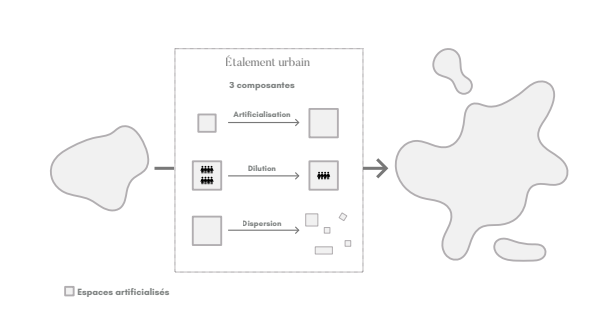
It is notably in the SDT that the notions of urban sprawl and land take are addressed.
The Municipal or Multi-municipal Development Scheme (SDC or SDPC)
The Municipal Development Scheme is a planning tool used by a municipality to define its territorial development strategy. It can also be drawn up jointly by several municipalities, in which case it is called a “Multi-municipal Development Scheme”.
This document identifies the main challenges, objectives and actions to be undertaken in order to promote the municipality’s economic, social, environmental and urban development. It takes into account the municipality’s specific characteristics and proposes concrete measures to improve residents’ quality of life, promote the rational use of resources, strengthen infrastructure and services, and effectively manage mobility issues.
The Municipal Development Scheme thus constitutes a roadmap to guide the municipality’s spatial planning and urban planning decisions with the aim of achieving harmonious and sustainable development. However, this document is not directly useful for the project owner. It is used more as an internal document within municipal administrations.
The Local Orientation Scheme (SOL)
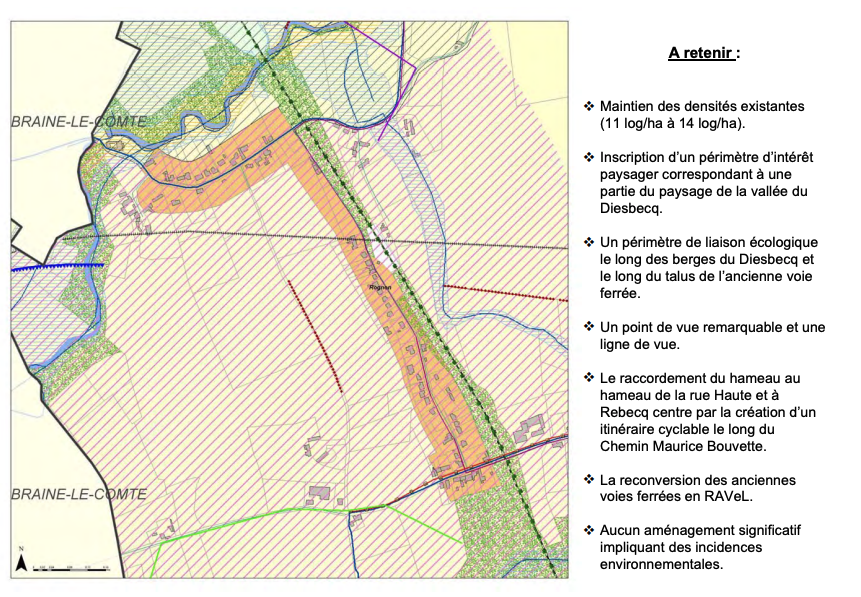
The Local Orientation Scheme (SOL) is a planning tool used to determine spatial planning and urban planning objectives for a specific part of the municipal territory.
Based on a contextual analysis including the main issues, the territory’s potential and constraints, the SOL includes spatial planning and urban planning objectives, as well as a detailed orientation map.

This map includes elements such as the road network, technical infrastructure, public spaces, green spaces, land-use zones, the ecological structure, and possibly the main landscape features. The SOL can also provide indications on the siting and height of buildings and structures, roads, public spaces and the integration of technical facilities. In addition, it can identify other SOLs and the municipal guide to be drawn up, revised or repealed. The SOL thus constitutes a guiding framework for steering spatial planning and urban planning in a specific area, promoting coherent and sustainable use of space.
The zoning plan
The Sector Plan
Usefulness of the sector plan
The sector plan is a document that sets out spatial planning in the Walloon Region. It defines the various planning sectors that will be the subject of a plan. Certain specific infrastructures, such as railway and airport infrastructure and autonomous ports, are not covered by this plan.
This zoning plan is inspired by the territorial development scheme, but may depart from it under certain conditions. It aims to protect, manage and develop landscapes, both built and unbuilt.
It applies to various development schemes, permits and urban planning certificates. Additional provisions may also be added, such as specifying or specializing the designation of zones, phasing their occupation, reversibility of designations, or the obligation to draw up a local orientation scheme prior to their implementation.
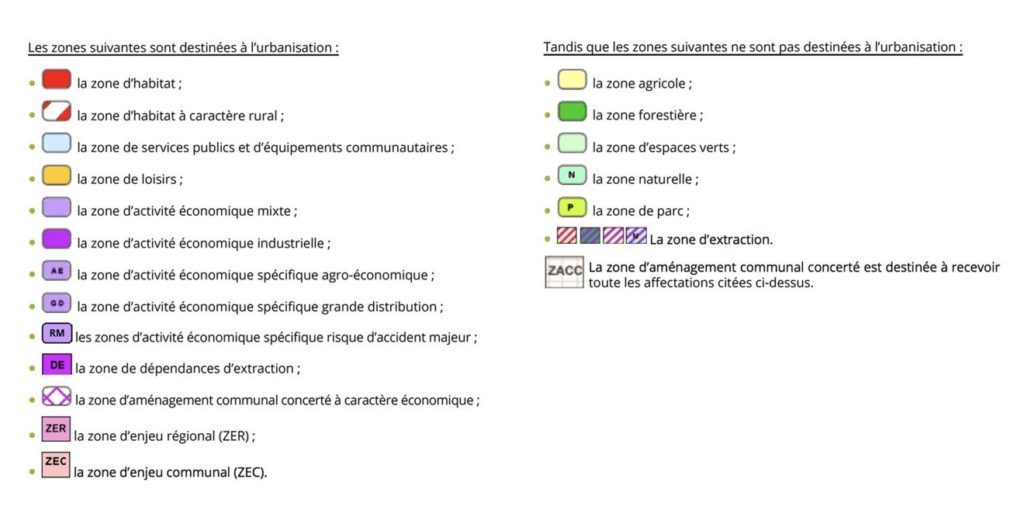
The designations in the sector plan can be divided into two groups:
- Zones intended for urbanization: these include residential zones, public service zones, leisure zones, economic activity zones, zones of regional interest and zones of municipal interest.
- Zones not intended for urbanization: these include agricultural, forest, green space, natural, park and extraction zones.
How to read the sector plan and where to find it?
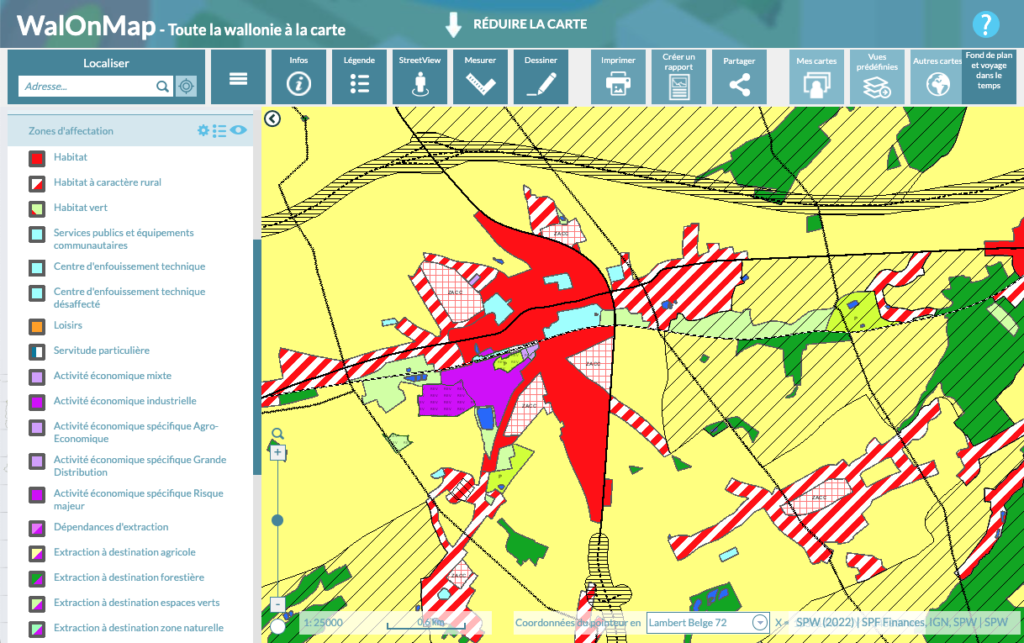
You can find the Sector Plan on WalOnMap
WalOnMap, what is it? WalOnMap is an application developed by the Walloon Public Service that allows users to display public geographic data on a map of the Walloon territory, while offering zoom, location, basemap selection and access to a variety of geographic information in different fields.
The tool thus makes it possible to identify a parcel based on an address, know its designation (agricultural zone, residential zone, etc.), the specific urban planning provisions that might apply, and study any associated risks (flooding, landslide, etc.)
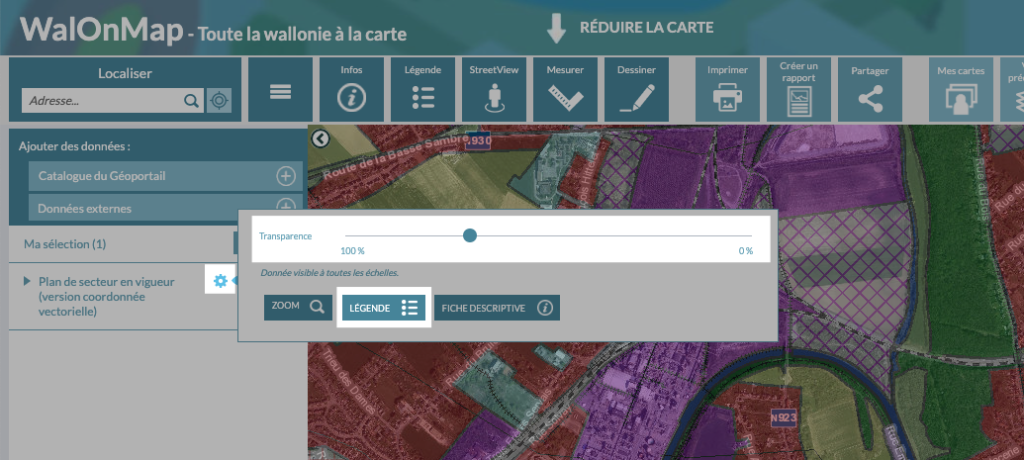
Tip: you can adjust the layer opacity in order to better see the boundaries of the sector plan. This will allow you, based on the satellite view and your knowledge of the place, to better perceive the boundaries of the sector plan in relation to the real world. To change the layer opacity:
– Click on the gear wheel on the left, at the level of your selection
– Move the slider to around 50%; this will make the sector plan partially transparent and reveal the satellite view just below.
– You can also display the legend by clicking the “Legend” button in the same menu. (link to the full legend document)
The regulations
Regulations in urban planning matters are called “Guides” in Wallonia and are available on the DGO4 website. There you will find, among other things, the following documents:
- The Regional Urban Planning Guide (GRU)
- The Municipal Urban Planning Guides (GCU)
We will cover the main useful sources of information below.
The Regional Urban Planning Guide (GRU)
The regional urban planning guide provides guidelines regarding the harmony of the built environment or standards for accessibility for people with reduced mobility.
By way of example, here are two excerpts from the GRU:
Gables, side façades and rear façades.
Regional urban planning guide – Unofficial coordination – 31 May 2017
The materials authorized for walls, gables, side façades and rear façades must harmonize with those of the street-facing façades.
Slopes:
Regional urban planning guide – Unofficial coordination – 31 May 2017
The cross slope or camber is a maximum of 2%.
When a longitudinal slope is necessary, it is ideally less than or equal to 5 centimeters per meter for a maximum length of 10 meters.
If it is technically impossible to use slopes less than or equal to 5%, the following slopes are exceptionally tolerated […]
The Municipal Urban Planning Guide (GCU)
Published at municipal level, this guide defines the applicable urban planning provisions and is intended to be the local implementation of the Regional Urban Planning Guide. It defines, for example, the morphology of the built environment, the siting of buildings, and setback and alignment conditions.
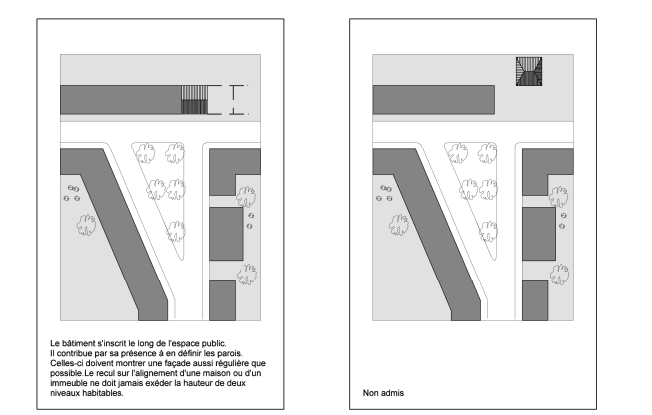
You will most often find this document on municipal websites. It is the reference document used to sketch out a real estate project.
Summary
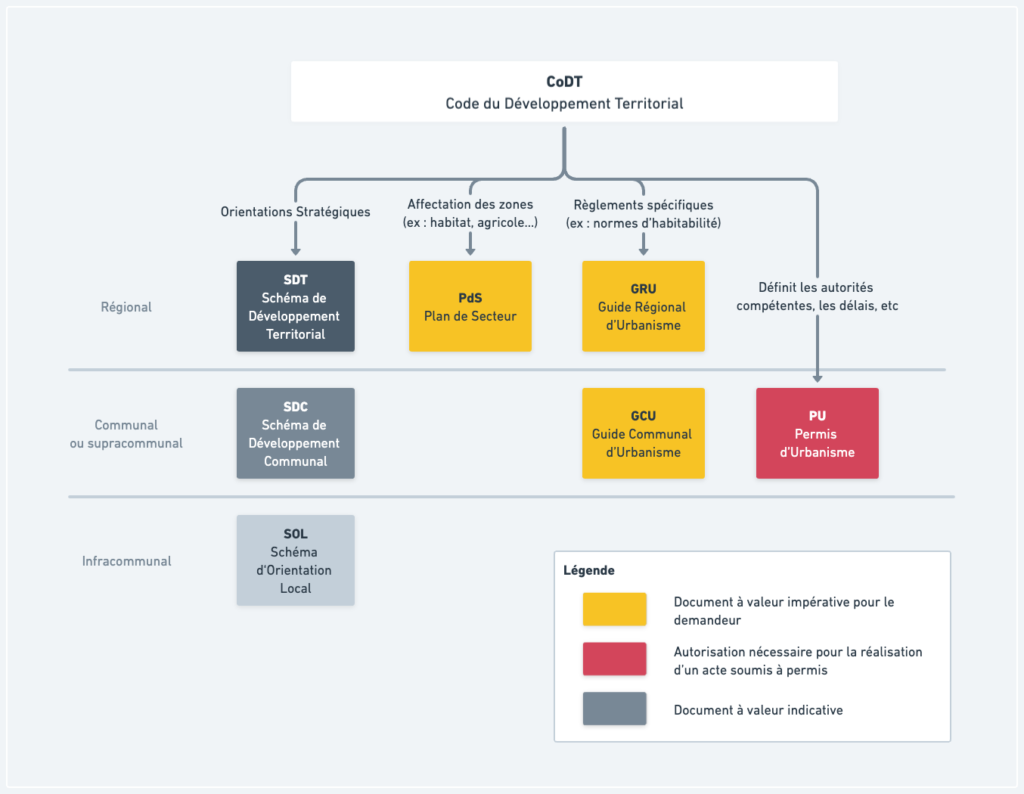
In Wallonia, it is the Territorial Development Code that governs Spatial Planning and Urban Planning. This text defines general rules such as acts subject to a permit, issuance deadlines, the competent authorities, as well as planning tools.
Among these tools, Schemes define the main strategic orientations, based on the issues of the territory concerned. These schemes are available at regional, supramunicipal, municipal and inframunicipal levels. They are not binding for the applicant, but can impact the municipality’s decision as to whether or not to grant the urban planning permit.
Guides define rules to be complied with in urban planning matters. These include, for example, habitability standards (minimum area, ceiling height, etc.) or construction standards (geometry, distance to the road, façade alignment, etc.). There is a Regional Guide that applies throughout Wallonia as well as Municipal Guides that apply locally and specify the local implementation of certain rules.
Ultimately, it is the municipality that is the competent authority for granting an urban planning permit. To do so, it reviews the file by analyzing the project’s compliance with the Sector Plan, regional standards (GRU) and local standards (GCU), as well as its alignment with strategic orientations (SDT, SDC, SOL).