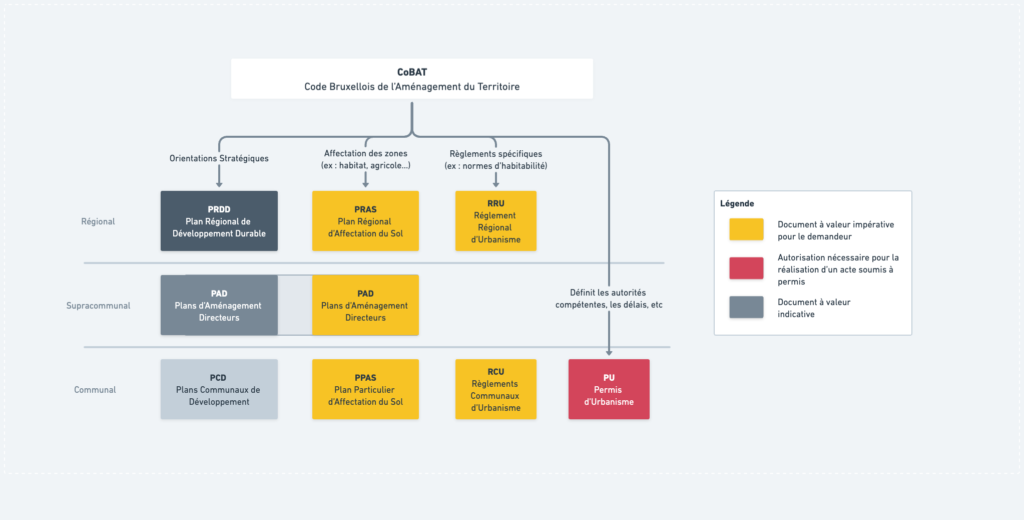

Are you interested in planning and urban planning law in the Brussels-Capital Region? This article aims to help you understand Spatial Planning in Brussels as well as to provide you with the essential resources and acronyms to study the feasibility of a project.
Introduction
Spatial planning and urban planning are two related but distinct concepts in their scope and objectives:
- Spatial planning concerns the planning and management of a territory as a whole, aiming to promote balanced and sustainable development by organizing the use of natural, economic and social resources. It addresses broader issues such as transport, the environment, public facilities and the preservation of natural areas.
- Urban planning focuses on the organization and management of urban spaces, whether already urbanized or intended to be. It examines the siting of buildings, the organization of neighborhoods, public spaces and urban infrastructure, with the aim of creating urban environments that are functional, aesthetic and suited to residents’ needs. It takes into account elements such as population density, mobility, architecture, accessibility and urban aesthetics.
Urban Planning and Spatial Planning is a Regional competence. As such, each region has its own legal basis, a code (CoDT, CoBAT, VCRO) defining the organization of this competence and its procedures. These texts specify in particular the following elements:
- acts subject to a permit (example: do you need to apply for a permit to build a swimming pool?)
- the competent authorities (example: which authority will decide for a given type of act, who draws up which plan, etc.)
- appeal procedures
- planning tools: these are all the tools that make it possible to establish strategies and define spatial planning and urban planning rules.
This article will focus particularly on planning tools in Belgium.
The legal basis: the CoBAT
The legal basis for urban planning in the Brussels-Capital Region is the Brussels Code of Spatial Planning (CoBAT). As such, the CoBAT governs the main mechanisms of spatial planning in Brussels:
- Planning (strategic development plans, land-use plans, etc.)
- Urban planning regulations (RRU, RCU)
- Permit applications (which works are or are not subject to a permit, competent authorities, time limits, appeal procedures, etc.)
- Heritage protection
- The right of pre-emption (a right of pre-emption is a legal or contractual right granted to certain private or public persons to acquire a property in priority over any other person, when the owner expresses the intention to sell it)
- Urban planning information (planning context of a specific property, to be obtained for any real estate sale)
Strategic plans
Strategic plans are documents that define and represent the strategy to follow in order to achieve specific objectives. These objectives are generally related to spatial planning. Strategic plans set out the main directions to follow and become the fundamental principles of territorial planning.
It is important to note that, in most cases, strategic plans have indicative (non-binding) value. The main regional development plans in force in Brussels are discussed below.
The Regional Development Plan (PRD)
The Regional Development Plan (PRD) sets the Region’s development objectives and priorities, based on economic, social, environmental and mobility needs.
In 2009, the PRD was supplemented with a second “D” for sustainable, symbolizing the region’s desire to address the major challenges of the century in terms of the environment and sustainable development.
Municipal Development Plans (PCD)
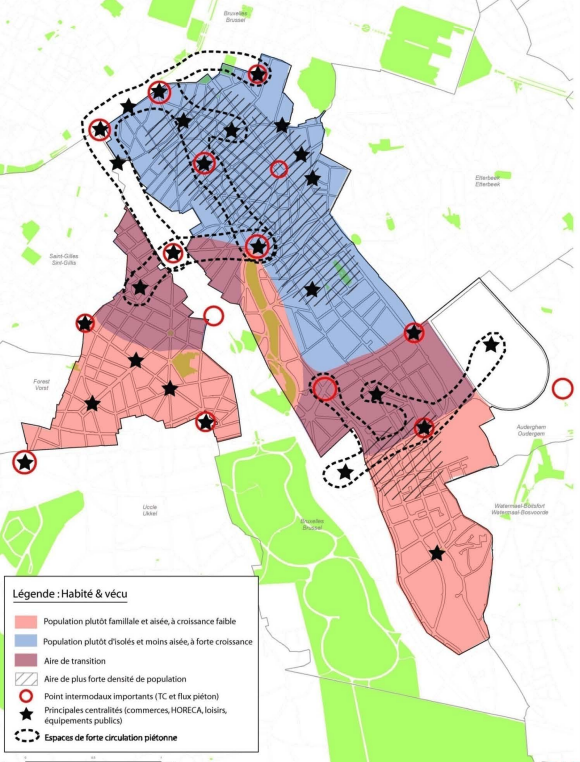
Municipal Development Plans (PCD) cover the entire municipal territory and constitute comprehensive planning tools for the sustainable development of municipalities. They are aligned with the PRD’s orientations and comply with the Regional Land Use Plan (PRAS), another regional development plan.
This is a comprehensive planning tool for the development of municipalities. It sets out the following points:
- General and specific objectives as well as development priorities, including spatial planning, necessary to meet economic, social, cultural, mobility, accessibility and environmental needs;
- Cross-cutting and sectoral measures to be put in place to achieve the defined objectives, in particular through a cartographic representation of some of these measures;
- Identification of the municipality’s priority intervention areas;
Regulatory plans
Unlike strategic plans, land-use plans with regulatory value determine the functions that may be established in the different zones of Brussels.
The Regional Land Use Plan (PRAS)
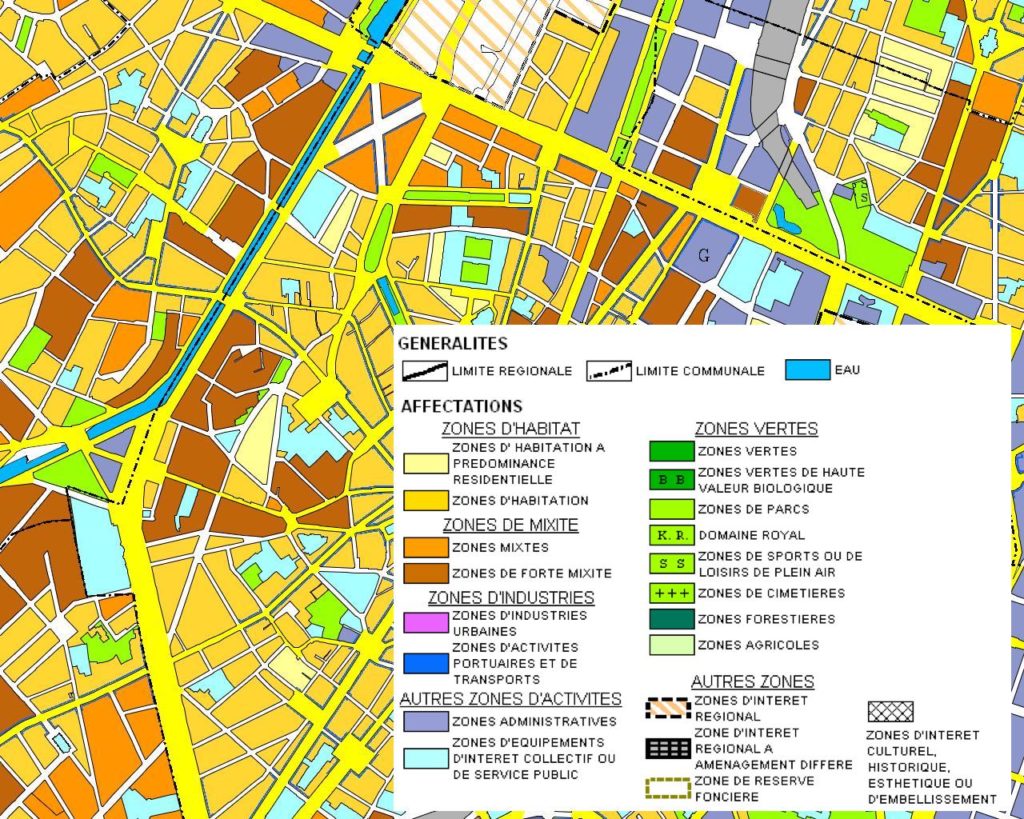
The Regional Land Use Plan follows the orientations of the Regional Development Plan (PRD) and determines the land-use designations of the territory of the Brussels-Capital Region and the rules that apply to them. The PRAS defines, for example, the primary designation of a zone (housing, commerce, etc.). A zone being defined by one or more blocks of parcels. The smallest graphic entity of the PRAS is the urban block.
The PRAS is in fact a set consisting of maps (plans) and written prescriptions (texts).
The 6 PRAS maps
| Map title | Value | Description |
|---|---|---|
| Existing situation in fact | Indicative | Current situation of designations as they are practiced today. |
| Existing situation in law | Indicative | Urban planning, heritage and environmental provisions applicable to the zone. |
| Land-use map | Regulatory | Equivalent of the Sector Plan in Wallonia, it defines the permitted designations by zone (housing, commerce, etc.). |
| Map of admissible office balances | Regulatory | Map indicating the balance of admissible m² of offices to assess a change of use. |
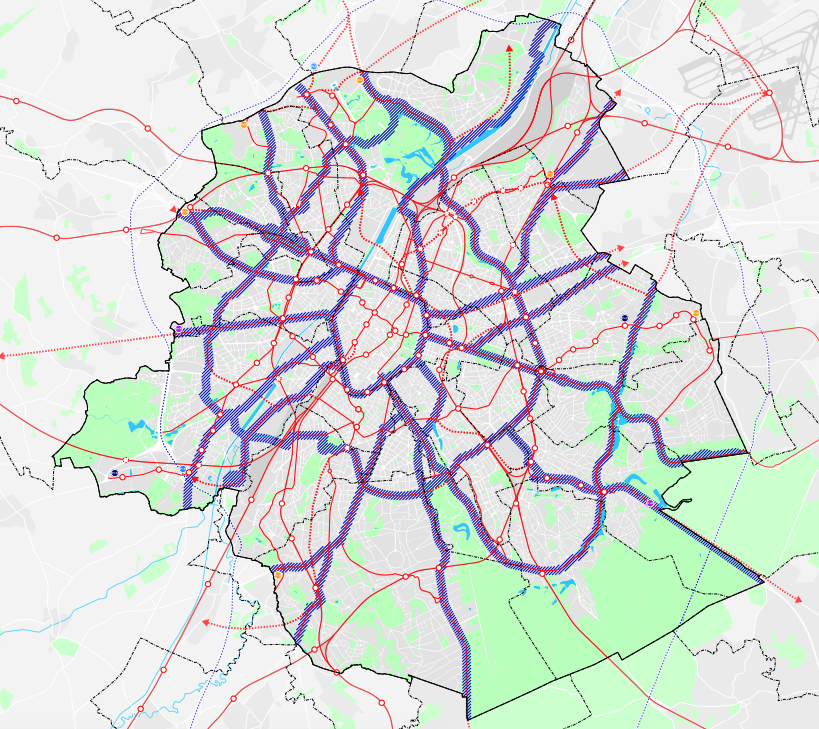
| Roads map | Regulatory | Regulatory map indicating roads and motorways within the Brussels perimeter. |
| Public transport map | Regulatory | Regulatory map of the public transport network, including underground and surface lines. |
The written prescriptions of the PRAS
There are different types of written prescriptions depending on their geographic or thematic scope of application:
- General prescriptions relating to all zones. Except where otherwise stated, the general prescriptions apply to all PRAS zones.
- Specific prescriptions relating to the different zones of the land-use map (housing, commerce, facilities, green spaces…).
- Specific prescriptions relating to roads and public transport.
- The program for Zones of Regional Interest (ZIR) and the Zone of Regional Interest with Deferred Development (ZIRAD).
Here is an example of specific prescriptions applicable to housing zones:
PRAS: Specific prescriptions relating to housing zones
- Outside the strips of commercial cores, the ground floors of buildings may be allocated to commerce. The first floor may also be allocated to commerce when local conditions allow and after the acts and works have been subject to the special publicity measures.
- The floor area allocated to commerce may not exceed, per project and per building, 150 m².
- However, the maintenance of at least one dwelling in the building must be ensured.
✅ It is important to note that zones are not always mutually exclusive. This implies that a parcel may, for example, be included in a Housing Zone AND in Zones of Cultural, Historical, Aesthetic or Beautification Interest, one not excluding the other.
The Master Development Plan (PAD)
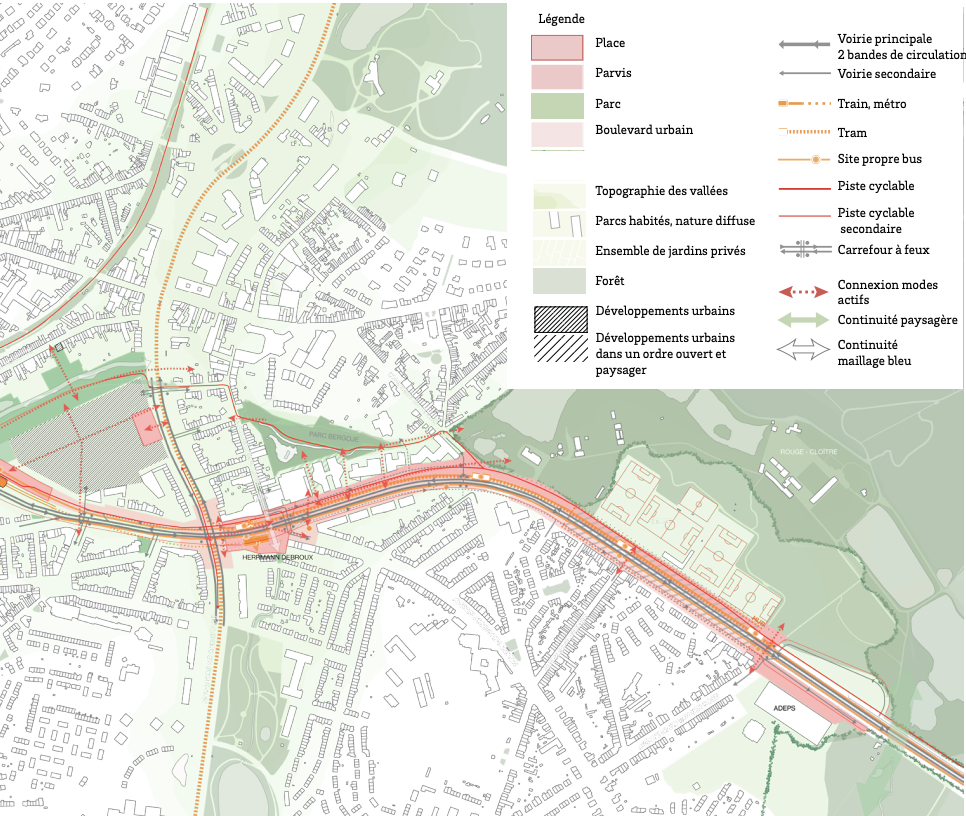
The Master Development Plan (PAD) is special in that it makes it possible to define both the strategic and regulatory aspects of a development strategy. Like the PRAS, the PAD is defined at the regional level but concerns a specific location.
All PADs are listed in the PAD dashboard. You will find, for example, the following PADs there: Bordet, Delta Hermaan-Debroux, Heysel, …
The Special Land Use Plan (PPAS)
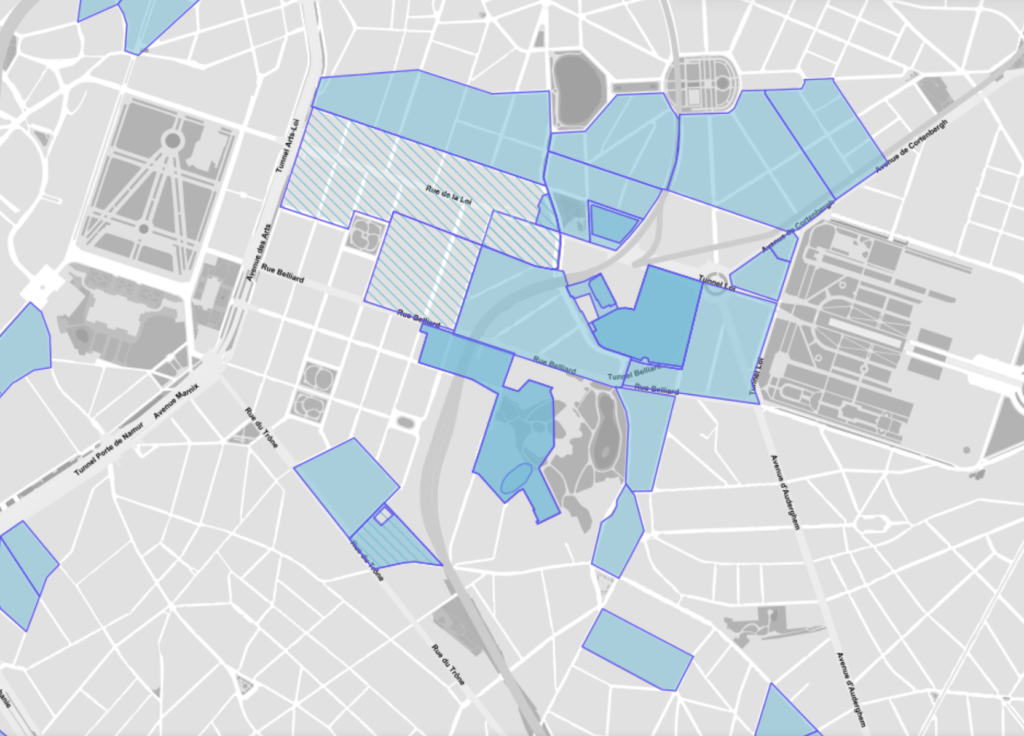
The Special Land Use Plan (PPAS) aims to specify and supplement the Regional Land Use Plan (PRAS). It complies with the orientations defined in the Municipal Development Plan (PCD) and establishes the detailed designations of the different zones. It regulates land use by delimiting buildable areas and green areas, as well as the rules associated with them. In addition, it may contain other provisions such as:
- Indications concerning the location, dimensions and aesthetic appearance of constructions and their surroundings.
- The routes and development measures for communication routes, as well as the regulations related to them.
You can find these plans on the BruGIS platform: https://gis.urban.brussels/brugis/#/
Regulations
The Regional Urban Planning Regulation (RRU)
The regional urban planning regulation includes 8 chapters (called “Titles”), which define very specific aspects of constructions and their surroundings:
| Title | Description |
|---|---|
| Title I | Characteristics of constructions and their surroundings |
| Title II | Housing habitability standards |
| Title III | Construction sites title partially repealed – cf. the coordinated version of Title III currently in force |
| Title IV | Accessibility of buildings for persons with reduced mobility |
| Title V | Thermal insulation of buildings title fully repealed |
| Title VI | Advertisements and signs |
| Title VII | Roadways, their access points and surroundings |
| Title VIII | Parking standards off the public roadway |
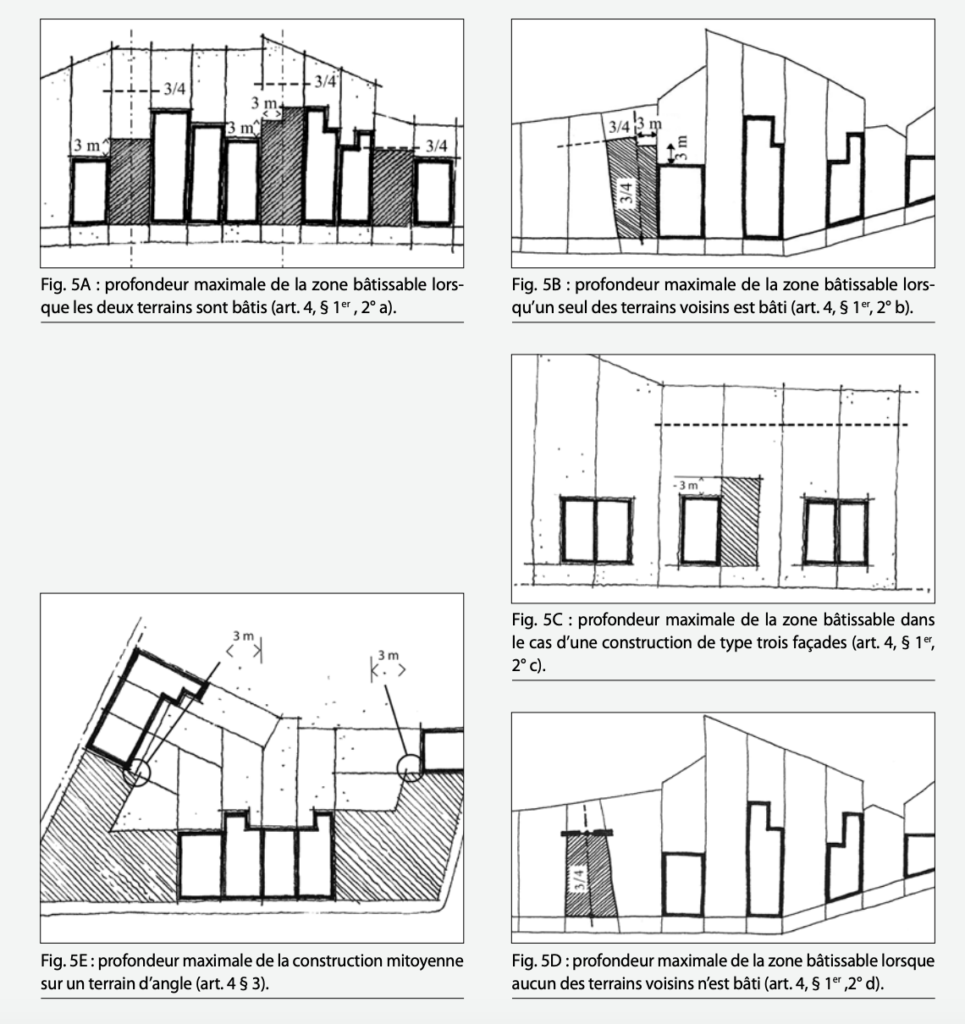
In Title I, for example, you will find the explanation of notions such as building alignment, party boundaries, etc. These notions define the building’s exterior visual characteristics.
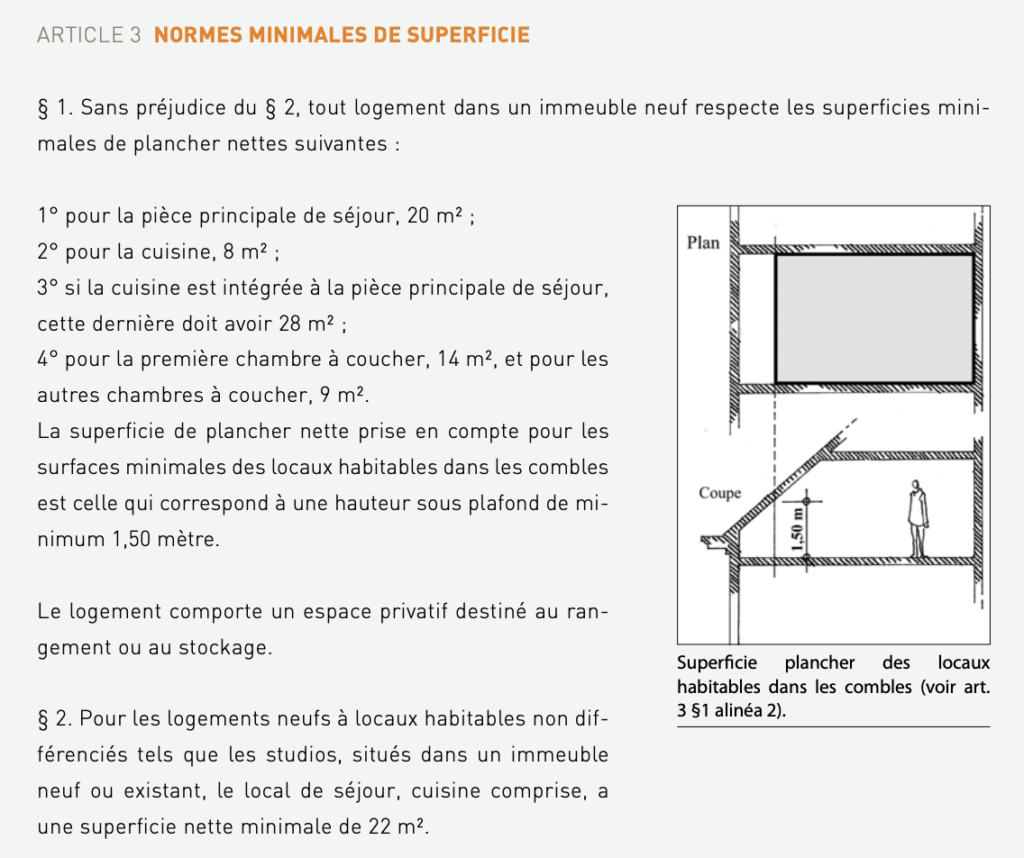
In Title II, habitability standards are defined, in terms of ceiling height and minimum habitable floor area.
The Municipal Urban Planning Regulation (RCU)
Municipal Urban Planning Regulations define additional rules compared with the RRU and may not contradict it. Depending on the municipality, these regulations may concern buildings, the placement of satellite dishes, sidewalks, and may apply to the entire municipality or only part of it.
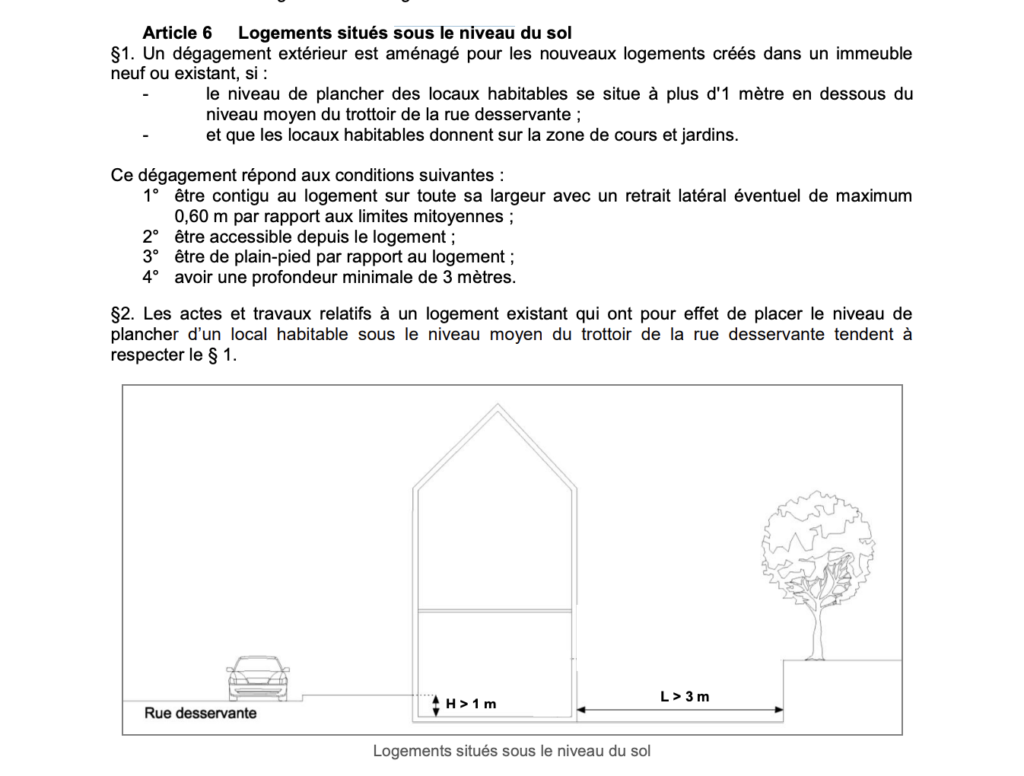
Some municipalities make their RCU freely accessible on the urbanisme.irisnet website or on their own website, whereas for others you have to go to the municipality to obtain the information.
Summary
In the Brussels-Capital Region, it is the Brussels Code of Territorial Development (CoBAT) that governs urban planning and territorial development. This code defines the rules, deadlines, competent authorities and planning tools necessary to implement an urban-planning policy.
Among these tools, Strategic Plans guide development policy from the regional level down to the municipal level. These plans are not directly useful for an applicant for a permit.
Regulatory Plans, on the other hand, are binding on the project owner. There are 3 of them:
- The PRAS: The Regional Land-Use Plan defines the possible land uses at the regional scale
- The PPAS: The Special Land-Use Plan is a municipal tool that defines development rules at the scale of a neighborhood.
- The PAD: The Master Development Plan is the regionally competent planning tool that makes it possible to define in a single move the strategic and regulatory aspects of an urban strategy. This plan applies only to certain specific areas.
In the Brussels-Capital Region, the issuing of urban-planning permits falls under the authority of the municipalities. In the event of an administrative appeal (following a refusal of authorization), permits are issued by the Government of the Brussels-Capital Region.